Spotify can be safe for children, but only when parents intentionally configure the account and actively supervise usage. The standard Spotify app was built for a general audience, not specifically for young users.
For children under 12, the Spotify Kids app offers stronger content controls and privacy protection. For older children using the main Spotify platform, safety depends heavily on parental setup, account structure, and digital education.
The difference between a safe experience and a risky one often comes down to how the account is managed inside the family.
Feature | Standard Spotify | Spotify Kids |
|---|---|---|
Designed For | General audience 13+ | Children ages 3 to 12 |
Content Access | Open search with millions of songs and podcasts | Curated and moderated child-friendly library |
Explicit Content Control | Relies on explicit labels and manual filter activation | Human-reviewed content with stricter screening |
Podcasts | Available with limited filtering | Not broadly available |
Social Features | Public playlists, followers, collaborative playlists | No public sharing or social interaction |
Privacy Exposure | Listening activity visible unless set to private | No public listening activity |
Advertising | Ads on free version | Ad-free under Premium Family |
Algorithm Influence | Personalized recommendations based on listening history | Limited algorithm exposure |
Account Structure | Can be shared across devices | Separate child profile within Family plan |
Spotify Kids is a separate app available under the Spotify Premium Family plan. It is built for children ages 3–12 and focuses on child-friendly music streaming.
Unlike the standard Spotify app, this version offers:
Curated and human-reviewed content
No public sharing features
Simplified navigation
Age-appropriate recommendations
No ads
It is designed to reduce risks related to online safety for children while still allowing kids to explore music independently.
One of the biggest safety gaps is not the platform itself. It is shared access.
Many families use a single Spotify account across multiple devices. Parents stream podcasts. Teens play music in their rooms. Younger children borrow the same login. It feels convenient.
But shared accounts remove digital boundaries.
Spotify’s recommendation system learns from listening history. If adults listen to explicit songs or mature podcasts, those preferences influence future suggestions across the account. Even if explicit filters are enabled later, algorithm-driven exposure may already be shaped.
In addition:
• Public playlists may contain inappropriate themes
• Collaborative playlists allow outside content contributions
• Listening activity may be visible to others
• Music links can be shared without parental awareness
When children use an adult profile, they inherit an adult digital environment.
From a digital parenting perspective, this matters deeply.
Children need age-appropriate spaces, not filtered versions of adult ones.
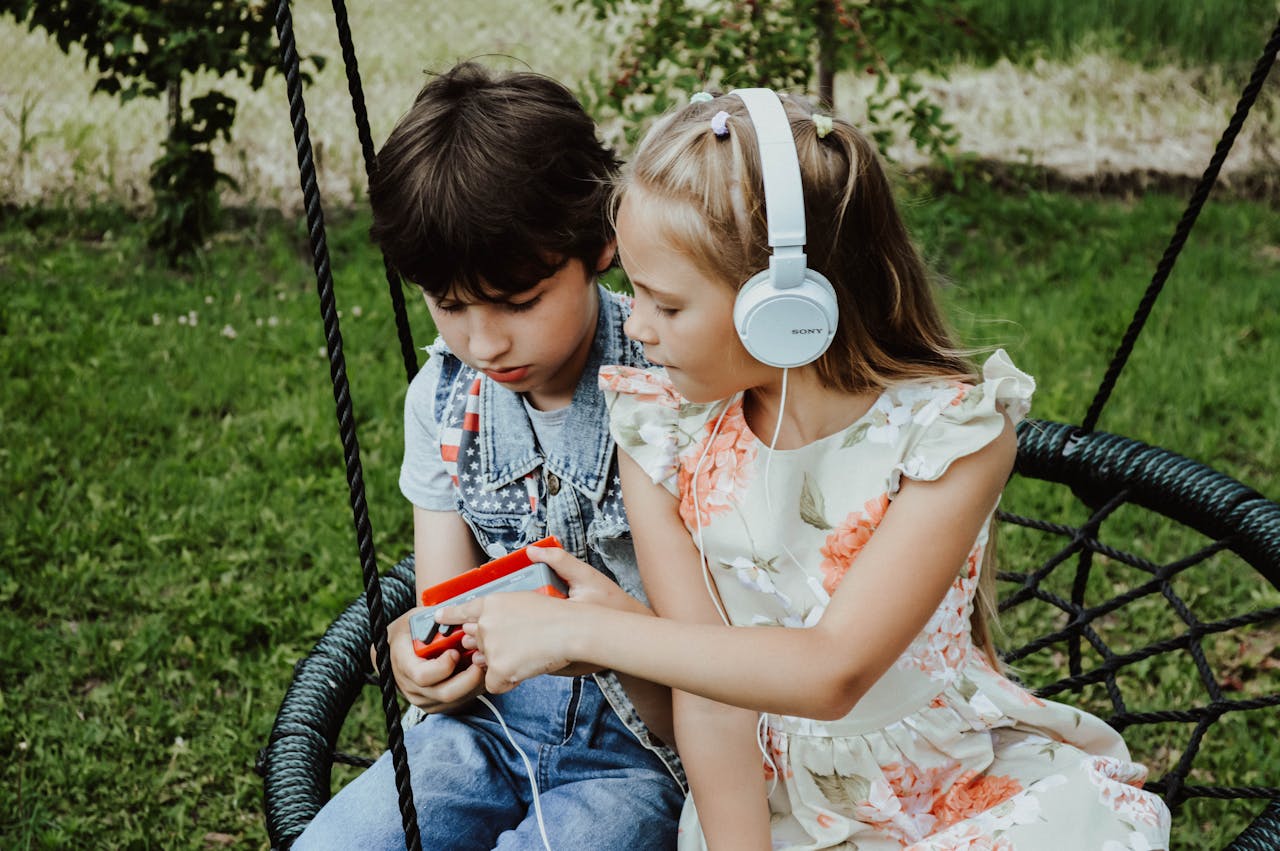
Many parents underestimate music streaming risks.
Even when explicit filters are turned on, standard Spotify still includes:
Mature themes
Podcast discussions not meant for kids
Public playlist exposure
Algorithmic recommendations beyond your control
For children experiencing early signs of nomophobia in kids or excessive kids screen time, algorithm-driven platforms can increase dependency.
Music itself is not the problem.
Unrestricted digital exposure is.
If used intentionally, Spotify Kids can support healthier digital behavior:
Human moderators review songs before they enter the kids’ catalog. This reduces exposure to explicit lyrics and adult themes.
No followers.
No public playlists.
No sharing metrics.
This lowers comparison anxiety and digital validation dependency.
Children can choose music within a safe environment. This builds autonomy without sacrificing digital parenting boundaries.
As digital parents, we worry about what our children consume online not only videos and games, but also music. Many families use Spotify daily, often through family sharing Spotify accounts.
But is regular Spotify really safe for children?
If your child already loves music and uses your account, it may be time to consider Spotify Kids a safe music app for kids designed specifically for young listeners.
This guide explains what Spotify Kids is, how it compares to standard Spotify, and how it supports healthier digital parenting in 2026.